

The Art Of Tracking In The Okavango Delta
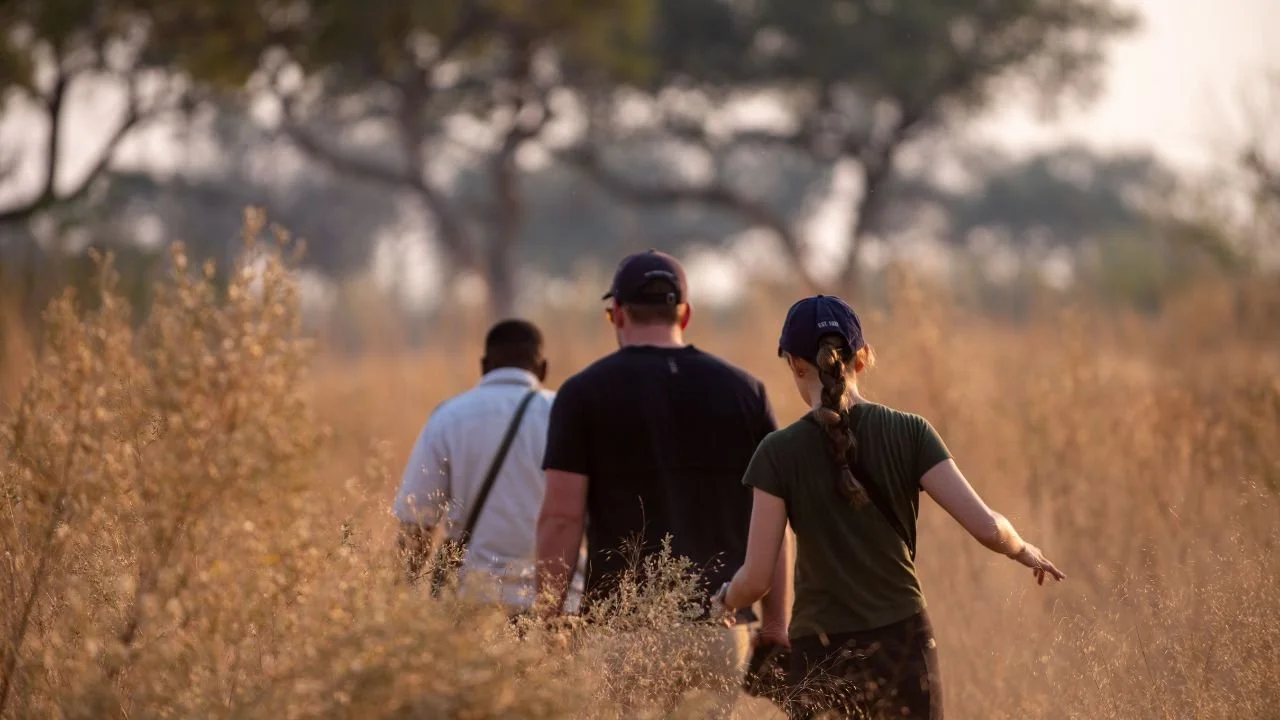
Group doing a walking safari.
While a traditional 4x4 game drive covers broad distances, a walking safari brings you directly onto the solid ground of the Okavango Delta. Stepping onto an isolated island with a professional guide transforms your role from a distant observer into an active participant in the wild.
A walking safari in the Okavango Delta is an exercise in sensory awareness and eco-literacy. On foot, the scale of the wilderness shifts entirely, revealing an intricate world of tracking, subtle alarm calls, and ecological connections that are easily overlooked from a safari vehicle.
The Shift in Perspective: Ground-Level Wilderness
At eye level, the Delta becomes a multi-sensory experience. You feel the crunch of dry grass underfoot, test the direction of the morning breeze on your skin, and smell the rich, earthy scent of damp soil. Subtle environmental sounds are vital tracking tools. A breaking stick or an animal's alarm call gives immediate information about hidden activity and proximity in the surrounding bush.
A walking safari demands a disciplined approach, as every step relies on silence, wind direction, and continuous visual scanning to interpret the landscape accurately.
The Art of Tracking: Reading the Wilderness
To a trained guide, the dusty paths and sandy game trails of the Okavango Delta are an open book. Every animal that passes leaves behind a story, recorded in tracks, scent marks, broken twigs, and animal droppings.
Reading Animal Tracks
Tracking goes beyond identifying whether a footprint belongs to a lion, leopard, or elephant. Master trackers read the subtlety of the impression:
Freshness and Age: The crispness of a track’s edges, whether windblown dust or fallen leaves have collected inside, or the presence of morning dew indicates how recently an animal passed through.
Direction and Gait: The depth of a heel print reveals whether an animal was walking calmly, trotting, or running in panic.
Behaviour: Drag marks from a tail, overlapping prints, or sudden changes in stride length can indicate a predator on the stalk or a herd reacting to danger.
Scent and Signs
Animal droppings provide a wealth of information regarding an ecosystem's health and recent activity. Fresh herbivore dung indicates proximity, while the contents of predator dung disclose recent kills, such as bones, hair, or hooves.
Distinct scent markers also provide early warnings long before an animal is seen. Trackers can identify the territorial marks of a leopard or the sharp, pungent musk of a dominant bull elephant well before making visual contact.
Micro-Ecosystems
While game drives cover broad distances to locate larger mammals, a walking safari focuses on the micro-ecosystems that support the broader landscape.
Termite Mounds: Engineering Marvels
The trail constantly changes level as you navigate around cathedral termite mounds. These massive towers of soil and saliva elevate you just enough to scan the surrounding floodplains, acting as essential vantage points for both trackers and local wildlife.
Flora and Natural Medicine
Beyond tracking wildlife, the trail exposes the practical uses of local flora, from crushing Wild Sage to act as a natural insect repellent, to identifying antibacterial twigs used for bush hygiene. Understanding the surrounding vegetation also provides critical tactical context, helping guides assess high-density feeding patches where larger game may be resting.
Trail Etiquette in the Field
Single-File Movement: Walking groups typically move in a single-file line behind the lead guide. This helps minimize the overall visual profile on the landscape, presenting a calm, consolidated outline to surrounding wildlife.
Maintaining Respectful Distance: The aim of a walking safari is quiet observation rather than close encounters. Keeping generous buffer zones allows wildlife to continue their natural behaviours uninterrupted.
Silent Communication: Basic hand signals and quiet cues are often established during the pre-walk briefing, keeping noise to a minimum so the group can pause or adjust position without disrupting the environment.
The Lasting Impact of a Walking Safari
Long after the dust settles on your boots, a walking safari leaves an indelible mark on how you perceive your daily surroundings. Back home, that trail-tested awareness lingers as you notice air currents, bird behavioural cues, and subtle tracks in the ground. It forces a complete reset from the rush of modern life, proving that the real transformation isn't just where you walked, but how you now move through the world.